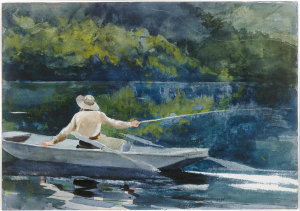
John Wilson (1922–2015) worked primarily as a draftsman and sculptor. He grew up in Boston, studied at the city’s School of the Museum of Fine Arts, helped establish the Museum of the National Center of Afro-American Artists, and taught art at Boston University for over 20 years. The National Gallery of Art has acquired Wilson's suite of five life-size, colored-crayon and charcoal drawings, and a compositional sketch for his unrealized mural Young Americans (c. 1972–1975), as well as one early watercolor, a monumental black-crayon study of a woman's profile, and three lithographs. Collectively, these works reveal the artist's passionate concern for the human condition and demonstrate his superb skill as a draftsman with a remarkable sensibility for creating dark tonalities and sculptural effects.
In the early 1970s Wilson's home in Brookline, Massachusetts, was the favorite hangout for his teenage children and their friends of all races, reflecting his interracial marriage and the progressive values the family upheld. This led to an idea for a mural, Young Americans, for which Wilson created a compositional sketch and individual life-size portrait studies of his children and their friends. Although the mural was never realized, these drawings stand as testament to what Wilson described as a hopeful moment in the early 1970s when greater racial harmony seemed within reach for his children's generation. Wilson saw that hope in notable Black political and cultural achievements, such as Shirley Chisolm's campaign for president, the establishment of the Congressional Black Caucus, the election of the first African American mayors in Newark, Los Angeles, and Detroit, and the first Pulitzer Prize for Drama awarded to an African American, Charles Gordone.