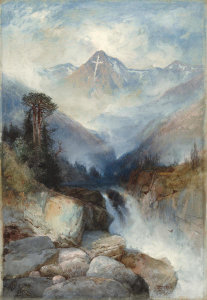

Thomas Moran saw the wondrous landscape that the world would come to know as Yellowstone National Park for the first time in the summer of 1871. He had journeyed west to join F. V. Hayden's survey expedition bound for a region rumored to contain steaming geysers and boiling mud pots. Traveling by train and stagecoach, he arrived in Virginia City, Montana, where he met William Henry Jackson, a young photographer whom Hayden had hired to document the purported "Wonders of Yellowstone." Moran and Jackson quickly became a team, working side by side to select subjects for photographs and sketches. Together they gathered the first visual evidence confirming stories of an astonishing region in the Far West full of geological marvels.
Hayden, Moran, and Jackson returned east in the fall of 1871. Required to submit a report to Congress, Hayden supplemented his survey data with photographs taken by Jackson. Soon Congress began drafting legislation to protect Yellowstone. In support of the proposal, Jackson's photographs and Moran's watercolors (the only color images available) were passed among congressmen on Capitol Hill. With nearly unprecedented speed, Congress approved a bill declaring Yellowstone the nation's first national park in the spring of 1872.