About the Artist
Born in Aix-en-Provence on January 19, 1839, Cézanne made his first trip to Paris in 1861, encouraged by his boyhood friend, the novelist Émile Zola.
Paris was the center of the art world, an essential destination for any up-and-coming artist, and Cézanne made repeated trips to the capital over the next dozen years, absorbing much that proved foundational to his subsequent artistic accomplishments. He frequented the Salon, studied the old masters and copied Delacroix at the Louvre, and forged friendships with many important artists, including Edouard Manet, James McNeill Whistler, Edgar Degas, Auguste Renoir, and Henri Fantin-Latour. But it was Camille Pissarro who became a pivotal, lifelong influence on Cézanne after the two met in the early 1860s at the Académie Suisse in Paris.
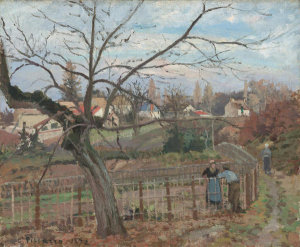
It was at the instigation of Pissarro that Cézanne arrived in Auvers in 1872 and began what is often dubbed his "impressionist" phase. Under the influence of the Barbizon painters Camille Corot, Charles-François Daubigny, and Théodore Rousseau, Cézanne had depicted landscape in his earlier work but it was through his close working relationship with Pissarro that Cézanne developed both his enduring interest in plein-air (outdoor) painting and a manner similar to that of the impressionists. Cézanne now placed more emphasis on the close observation of nature and on the rendering of light and atmospheric effects, producing works with a lighter palette and freer brushwork that he exhibited in Paris at the impressionist exhibitions of 1874 and 1877. It was also during the 1870s, and up to 1885, that Cézanne began to paint in L'Estaque, a site that has rightly been seen as engendering Cézanne's maturation as an artist. It was there, during the mid-1880s, that he painted his great views of the Gulf of Marseille.
From the mid-1880s until Cézanne's first solo exhibition, organized in Paris in 1895 by his dealer Ambroise Vollard, he entered into his full artistic maturity, adopting a characteristic style in which paint was applied in regular, hatched strokes-his so-called "constructive stroke." For Cézanne this way of working grew out of his intent to produce paintings that captured solid form rather than the fugitive effects rendered by the impressionists. He depicted the gamut of subjects in all media: landscapes around Pontoise and especially Provence, notably his first images of the Montagne Sainte-Victoire, as well as still-lifes, portraits, and self-portraits. His last great achievement was his serial paintings of bathers, a theme he treated throughout his life, culminating in three oversize canvases executed at this time. The latter recast both longstanding notions regarding the nude and the relation of figure to landscape.
Cézanne died at 7:00 a.m. on October 23, 1906, at his home, 23 rue Boulegon in Aix.
Source: Benedict Leca, Mellon Curatorial Fellow, Department of European and French paintings