A cloud of canary-yellow flowers with pumpkin-orange centers on tall stems with emerald and pine-green leaves fills the top half of this vertical still life painting. The flowers, vase, the round tabletop on which they sit, and the background are loosely painted with visible brushstrokes of vibrant color. The flowers have long, pointed petals like daisies. The bouquet is rimmed with a ring of verdant leaves near where the stems gather in the narrow neck of the cylindrical, ivory-white vase. The vase might sit on a circular cloth edged with alternating sage-green and plum-purple forms like pompoms, but the loose painting style makes these details difficult to make out. The round tabletop is cropped by left and bottom edges of the canvas. The background behind the bouquet and table is painted with long, vertical brushstrokes in salmon pink, pale turquoise, denim blue, and creamy white. The artist signed and dated the painting in red in the lower right corner: “Claude Monet 1880.”
Born in Paris in 1840, Claude Monet was raised on the Normandy coast in Le Havre, where his father sold ships’ provisions. He gained a local reputation as a caricaturist while still a teenager, and landscape painter Eugène Boudin invited the budding artist to accompany him as he painted scenes at the local beaches. Boudin introduced Monet to plein air (outdoor) painting, which would prove a decisive influence in his career.
Monet went to Paris in 1862 to study painting and there befriended fellow students Auguste Renoir, Alfred Sisley, and Frédéric Bazille, who would later form the core group of the original impressionists. By the end of the 1860s Monet had largely abandoned ambitious, large-scale figurative painting in favor of smaller, spontaneous landscape works executed en plein air.
Monet fled to London during the Franco-Prussian War, and in late 1871 settled at Argenteuil, a suburb just west of Paris that maintained its rustic charm even as it underwent rapid modernization. From 1872 to 1876 Argenteuil became the hub of what would soon be known as impressionist painting. Monet and his colleagues organized an exhibition of their work in Paris in 1874; one of Monet’s exhibited works, Impression, Sunrise (1873), a loosely painted sketch of an industrial seascape, led critics to derisively dub the group “the impressionists.” Financial difficulties forced Monet to relocate to Vétheuil in 1878, and a few years later, in 1883, he settled in Giverny, where he would live for the rest of his life.
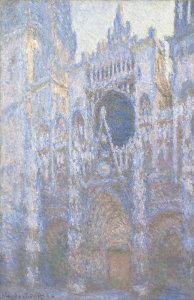
Most of Monet’s paintings from the 1870s depict the landscape in and around the small towns along the Seine. Executed outdoors, he employed seemingly spontaneous brushstrokes to capture the ever-changing effects of light and atmosphere. In the 1880s Monet expanded his motifs, turning his attention both to the Mediterranean and to the rugged vistas along the Normandy coast. In the 1890s he undertook a number of paintings produced in series, including pictures of poplars, grainstacks, and Rouen Cathedral; each work captured a specific atmospheric effect and time of day. With his reputation as France’s leading landscape painter established and his financial situation secure, the artist turned his attention to the lavish gardens he had constructed at Giverny, eventually creating more than 250 works focused on water lilies.